

Introducing Narrative Design Thinking
Written by Anh Le - Co-founder & CEO of Souls Lab


Today, we’ll publicly introduce our Narrative Design Thinking model - our attempt to bring more structure and intentionality to how narratives are formed in technology markets.
Understanding The Web3 Characteristic
Web3 is a fundamentally different paradigm of the internet - one where ownership, coordination, and value creation are embedded directly into the system itself.
To understand the dynamics of Web3, we first need to look at the nature of Web3 itself.
The evolution of the internet from “read” to “write” to “own”, a framework popularized by Chris Dixon - Founder & Managing Partner of A16z - did not just introduce new technologies. It fundamentally reshaped how value is created, distributed, and perceived.
Web3 represents the next stage in this evolution: the shift toward “own.” Through blockchain-based infrastructures, users are no longer just participants but stakeholders, with the ability to hold, transfer, and capture value directly within the systems they engage with. This ownership thesis matters because it changes how value and power are distributed: not only to companies, but to builders/users as stakeholders in the network.
Web3 ecosystems are inherently community-centric, with users who are economically and ideologically aligned with the success of the project. As a result, value is not determined solely by product functionality, but also by collective belief and coordination. Because of this, participation extends beyond usage - to speculation, contribution, and early alignment around emerging ideas. This lowers the barrier for new projects to form and gain traction, even before products are fully mature.
This dynamic became acutely visible between 2021 and 2025, when the number of crypto projects expanded from roughly 428,000 to nearly 20.2 million. It was a period of rapid experimentation but also failure at scale.
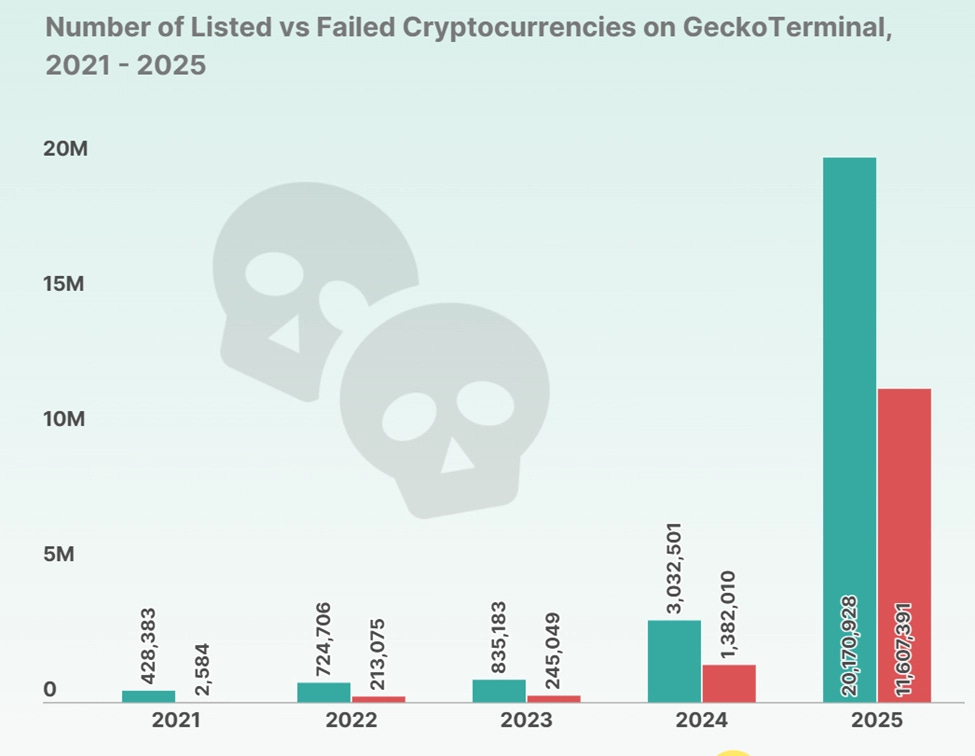
Even among funded projects, success remained highly concentrated.
Only a small percentage achieved meaningful adoption
And only a small fraction reached breakout scale
In many cases, technically strong projects failed to gain traction. Meanwhile, others, often less mature from a technical perspective, were able to mobilize communities and attract capital. For example, meme-driven assets like Dogecoin or Pepe achieved massive attention, liquidity, and cultural relevance despite minimal technical differentiation.
This raises a fundamental question:
Why do so many well-built products fail to generate momentum, while others succeed without strong technical foundations?
As the market matures, this question becomes harder to avoid. Users are more selective. Capital is more cautious. Institutions are engaging more seriously. Success is no longer driven by novelty alone - it depends on the ability to build sustained participation and long-term alignment.
The challenge is no longer just building products. It is bringing those products to market in a way that people can understand, believe in, and commit to over time.
This is where a deeper shift begins to emerge.
And understanding this shift requires moving beyond how information spreads, toward how belief is formed in the market.
The Hype Shift: From Information Economy to Conviction Economy in Web3
How the Internet Evolved
The early internet is often described as the Information Economy (1990s – early 2000s). In this phase, value was created by organizing, structuring, and distributing information at scale. Search engines, directories, and early web platforms competed on their ability to make information accessible and navigable in an increasingly complex digital landscape.
As the web matured, this model evolved into the Attention Economy (mid-2000s – 2010s). In a world of information abundance, attention became a scarce resource. Platforms like Google, Facebook, and YouTube built massive businesses by capturing, optimizing, and monetizing user attention - turning engagement into the primary currency of the internet.
This, in turn, expanded into the Creator Economy (late 2010s - present), where the ability to produce and distribute content became widely democratized. In this phase, individuals and communities can operate as economic actors in their own right - building audiences, shaping culture, and monetizing their work directly, without relying on traditional intermediaries.
Importantly, each phase did not replace the previous one - it built on the previous one. Information still matters. Attention still drives distribution. Creation still fuels engagement.
But as the ecosystem continues to evolve, we believe a new dynamic is beginning to emerge. With the rise of Web3 and AI, markets are no longer driven solely by access to information, the ability to capture attention, or even the capacity to create content. Instead, they are increasingly pushing toward another phase - one we describe as:
The Conviction Economy.
What’s The Conviction Economy?
In this emerging paradigm, markets are no longer driven primarily by access to information, the ability to capture attention, or even the capacity to create content.
They are driven by the degree to which participants believe in a particular vision of the future and are willing to act on that belief.
In this framework, belief and conviction are not the same thing. Belief is the initial state - when a participant finds a narrative coherent and plausible enough to accept. Conviction is what belief becomes when it is tested and reinforced through action: putting in capital, time, or reputation. A person can believe in an idea without acting on it. Conviction implies they already have.
Conviction is expressed through participation:
Investing capital
Contributing time and effort
Building on top of a system
Advocating for it and expanding its network
In environments like Web3 - where technologies are complex, outcomes are uncertain, and products are often incomplete at launch - conviction becomes a primary driver of market behavior. People are not simply evaluating what exists today, but committing to what they believe could exist in the future.
This raises a fundamental question: Where does conviction come from?
It does not emerge automatically from the product itself. Nor does it come from raw information, which is often fragmented, technical, and difficult to interpret.
Conviction forms when uncertainty is reduced into a coherent interpretation of the future - something people can understand, relate to, and align around.
This is where narrative becomes critical.
Narrative is not simply messaging. It is a sense-making mechanism - a way to structure information, frame possibilities, and make an uncertain future legible to a broad set of participants.
An important caveat: We are not arguing that narrative replaces product quality, or that conviction alone produces sustainable value. As the examples below will show, narratives can drive rapid adoption and equally rapid collapse when they outpace reality. The Conviction Economy framework describes a real dynamic in how markets coordinate, but it does not imply that belief is sufficient. Products still need to be delivered. Conviction that is not eventually grounded in reality dissolves often destructively.
Three Examples: How Narrative Shapes Web3 Markets (and What They Really Teach Us)
Example 1: Bitcoin And The Narrative Of “Digital Gold”
From the beginning, Bitcoin’s functionality was relatively narrow.
It did not offer programmability, complex applications, or a broad ecosystem of use cases. What it offered was a simple and powerful narrative: “digital gold” - a scarce, censorship-resistant store of value independent of traditional financial systems.
This narrative did not depend on immediate utility. It reduced uncertainty by providing a clear mental model for how Bitcoin should be understood and valued. Participants did not need to fully understand the underlying technology. They only needed to believe in the idea of a non-sovereign store of value.
That initial acceptance was belief - not yet conviction.
Belief, at this stage, was fragile. It had not been tested. The price was near zero. The community was tiny. Most people who heard about Bitcoin in 2009 found the narrative interesting but took no action on it.
In 2009, Bitcoin launched with near-zero value and a small group of early adopters.
By 2017 (~8 years later), it reached nearly $20,000, driven largely by growing conviction and speculative demand.
By 2021–2024, Bitcoin saw mainstream institutional adoption, with companies like Tesla and MicroStrategy adding BTC to their balance sheets, and asset managers like BlackRock launching spot Bitcoin ETFs.
As of recent years, Bitcoin has reached a market capitalization of over $1 trillion at peak, with hundreds of millions of users globally and recognition as a macro asset class. And this snapshot highlights a key shift in 2026: institutional participation is no longer emerging - it is now the dominant force driving Bitcoin adoption, capital inflows, and infrastructure growth.
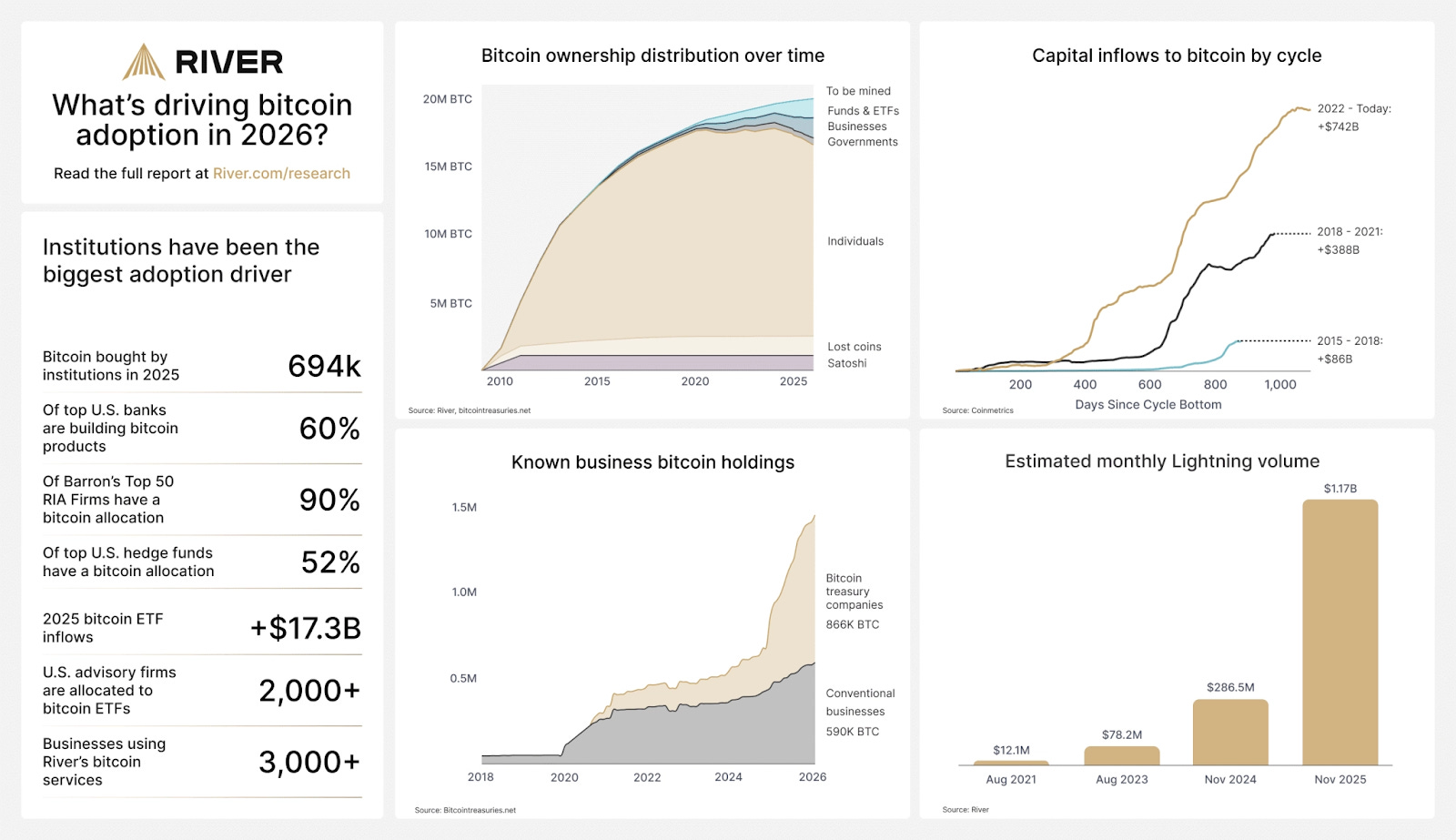
What transformed belief into conviction was repeated exposure to adversity. Bitcoin went through multiple crashes of 80% or more and each time, a subset of holders chose not to sell. Within the community, this behavior became known as “HODL”.
Those who chose to HODL were not reacting to short-term price movements. They held through the collapse because the underlying narrative - digital scarcity, non-sovereign value - had not changed. That choice to act against short-term incentive, to continue holding when the market disagreed, is what conviction looks like behaviorally. It is belief that has been stress-tested and survived.
The key was not narrative complexity, but narrative “consistency”. The “digital gold” frame never required rewriting, because it was grounded in a genuinely scarce underlying technology.
→ The lesson: Narrative durability requires a real foundation. Bitcoin’s story survived because the scarcity it promised was real and verifiable.
Example 2: Ethereum And The Narrative Of A “World Computer”
In late 2013, Vitalik Buterin introduced the idea of Ethereum through its whitepaper. At the time, Ethereum was not a complete or scalable system. The technology was experimental, tooling was immature, and the range of real-world applications remained unclear.
What existed was a narrative: the idea of a “world computer” - a programmable, decentralized platform where anyone could build applications without relying on centralized intermediaries.

This narrative did not reduce uncertainty by proving what already worked. It reduced uncertainty by framing what could be built.
For developers, it turned blockchain from a payment system into a programmable environment.
For founders, it opened up the possibility of entirely new product categories.
For investors, it positioned Ethereum not as a single application, but as infrastructure for an ecosystem
But conviction did not truly emerge until developers began to build on it. What transformed belief into conviction was the decision to build on an incomplete platform.
Developers who began writing smart contracts in 2014 and 2015 before Ethereum was stable, before tooling was reliable, before any successful application existed were not acting on information. They were acting on a belief that had crossed a threshold: they were willing to invest real time and effort into something that might not work, because the narrative had convinced them the underlying possibility was genuine.
In Web3 culture, this behavior is often described as “BUIDL” - a deliberate reframing of “build” that emphasizes long-term creation over short-term speculation.
Those early contributors embodied this ethos before it was widely named. They were not waiting for certainty. They were building into uncertainty, treating the platform not as a finished product, but as a space of possibility.
And that conviction translated into coordinated action at remarkable speed:
In 2014, Ethereum raised ~$18M through its ICO, bootstrapping the ecosystem around Ethereum Foundation.
By 2017-2018 (within ~2–3 years), Ethereum had already become the foundation for the ICO boom, coordinating billions of dollars in capital across hundreds of projects.
By 2020–2021, it powered the rise of DeFi and NFTs, with total value locked (TVL) in DeFi alone reaching tens of billions of dollars, and millions of users interacting with on-chain applications.
As of recent years, Ethereum supports thousands of active developers, millions of wallet addresses, and a market capitalization that has reached hundreds of billions of dollars at peak.
Crucially, Ethereum’s narrative preceded its product and made its development possible. The “world computer” idea gave developers a reason to build before the platform was ready, creating a self-reinforcing cycle: conviction drove participation, participation built legitimacy, and legitimacy deepened conviction.
→ The lesson: Narrative can precede product, but only when the underlying technical possibility is real. The “world computer” narrative worked because smart contracts were genuinely buildable. It attracted the people who then built the thing the narrative described.
Example 3: Axie Infinity And The Cautionary Arc Of “Play-To-Earn”
Axie Infinity is one of the most iconic success stories in Web3 and one of the very few unicorns to emerge from Vietnam.
At its core, Axie was not the most technologically advanced product. What made it powerful was the narrative it introduced: “play-to-earn” - the idea that people could generate real income simply by playing a game.
This narrative landed at a very specific moment. During COVID-19, when millions of people globally - especially in Southeast Asia - were facing economic uncertainty, Axie reframed gaming from entertainment into economic opportunity.
By mid-2021, Axie Infinity reached over 2 million daily active users, with strong adoption in countries like the Philippines and Vietnam.
At its peak, the game generated over $1 billion in cumulative revenue, becoming one of the highest-grossing blockchain applications at the time.
The native token, AXS, surged from under $1 in 2020 to over $150 in 2021, pushing the project to a multi-billion dollar valuation.
Entire micro-economies formed around the game, including “scholarship” systems where asset owners onboarded new players - effectively turning communities into distributed labor networks.
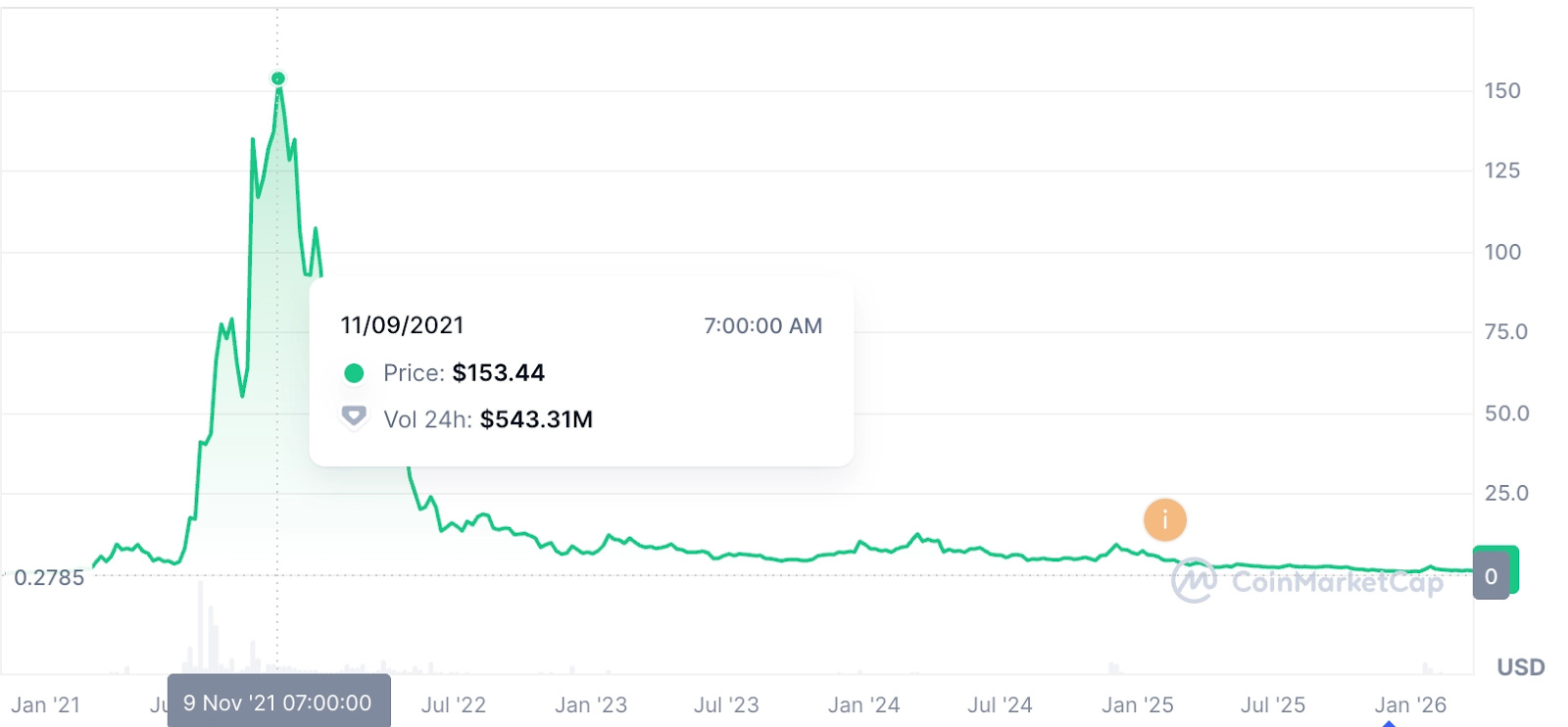
But the story did not end there.
By early 2022, the Ronin Network - Axie’s blockchain sidechain - suffered a $625M hack, one of the largest in crypto history. More structurally, the play-to-earn model itself collapsed: the token economy required continuous new entrants to sustain rewards, a dynamic that eventually became unsustainable. As prices fell, the income that had driven adoption evaporated, and daily active users plummeted.
Axie’s collapse is not evidence that narrative is unimportant. It is evidence that narrative disconnected from sustainable economics is fragile. The “play-to-earn” story was powerful precisely because it spoke to real human needs but it was built on a tokenomic model that could not fulfill the promise at scale.
→ The lesson: Narrative can create economic behavior at scale, extraordinarily fast. That makes it powerful and dangerous. When the narrative outruns the product’s ability to deliver, collapse can be as rapid as adoption. A genuine Narrative Design Thinking framework must account for this: the goal is not to generate maximum belief, but to build grounded conviction that the product can sustain.
Why This Shift Is Happening in Web3
Unlike traditional technology products, most Web3 systems are not immediately intuitive. They are often complex, abstract, and unfold over long time horizons. Concepts such as decentralized ownership, token economies, or on-chain governance are not easily understood through product features alone.
As a result, the market cannot rely purely on functional understanding. It relies on narratives to frame interpretation from the very beginning. In Web3, narratives do not emerge after products are understood. They shape how products are understood.
In the earlier phases of Web3 markets, momentum was often driven by information shocks - announcements of new tech innovation (DeFi, NFTs, new L1s - at one point even sparking debates about why the market needed hundreds of L1s) rumors, exchange listings, influencer posts, or trending keywords that could trigger rapid spikes in attention.
Go-to-market strategies during this phase were built around what can be described as Campaign Thinking:
Rolling out announcements in waves
Designing short-term incentives (airdrops, liquidity mining)
Leveraging KOLs to amplify reach
These approaches were highly effective at generating immediate traction in both capital and social attention.
But they were also fragile.
As the market moved through extended bear cycles, particularly over the past two years, this dynamic began to change.
Retail sentiment weakened, becoming more cautious and selective
Communities began questioning the real purpose and long-term value of the projects they were supporting
Regulatory frameworks started to emerge across regions, both enabling institutional participation and enforcing stricter compliance standards
Participants began searching for something deeper, not just signals to react to, but frameworks to believe in.
Instead of reacting to isolated bursts of information, the market starts to organize around more persistent narratives - frameworks that help participants interpret what a technology represents and why it matters over the long term.
These narratives shape belief.
When belief is reinforced through participation, it becomes conviction.
And this is what I refer to as Conviction systems - structures of belief that accumulate, sustain, and coordinate action over time.
Early Signals Pointing To A Conviction World
A trend highlighted in “Companies Are Desperately Seeking Storytellers” (The Wall Street Journal) points to a shift in how institutions operate. Firms are increasingly hiring individuals who can shape how strategies, markets, and opportunities are interpreted - not just analyzed.
Even in environments historically driven by data and financial models, the ability to frame a compelling narrative is becoming critical to influencing capital allocation.

Two institutions illustrate how this works at scale not as Web3-specific examples, but as models for how narrative infrastructure operates across any technology market.
Andreessen Horowitz (A16z) never operated like a traditional venture firm that simply deploys capital. From its founding in 2009, media was treated as a core strategic function. Communications leader Margit Wennmachers helped build the firm’s media operation almost from the start. At one point, A16z reportedly had more marketers than investors before it had even established a track record - an unusual but deliberate choice.
Over time, this evolved into something much larger: a clear “techno-optimist” philosophical frame, a multi-vertical publishing operation across newsletters, podcasts, and essays, annual “Big Ideas” reports, and initiatives like Speedrun and a dedicated New Media team. Taken together, A16z is not just funding startups. It is building infrastructure for how ideas circulate, gain visibility, and accumulate belief across the technology ecosystem.

Y Combinator (YC) took a different path. YC has never branded itself as a media company, yet it may be the most structurally influential narrative engine in venture history. Essays by Paul Graham - “Do Things That Don’t Scale”, “How to Start a Startup” - became canonical texts that defined the mental models through which entire generations of founders think about iteration and product-market fit. Startup School turned key lectures into an open curriculum.”Demo Day” evolved into a concentrated broadcast moment where selected narratives about emerging companies are introduced to the market.

The result is a powerful form of narrative persistence: by consistently articulating the same startup philosophy across decades, YC embedded its intellectual DNA across multiple founder generations.
It is worth noting that both A16z and YC operate across all of technology, not Web3 specifically. Their strategies work because narrative infrastructure is valuable in any market where ideas are complex and outcomes are uncertain. Web3 simply makes this dynamic more acute which is why a structured approach to narrative becomes especially important there.
Design Thinking, Reapplied To Narratives
If the challenge is no longer just building products, but helping markets understand and believe in them - where do we look for a structured way to approach this?
One useful reference point comes from Web2.
For decades, one of the most widely adopted frameworks for building successful products has been Design Thinking, popularized by IDEO.
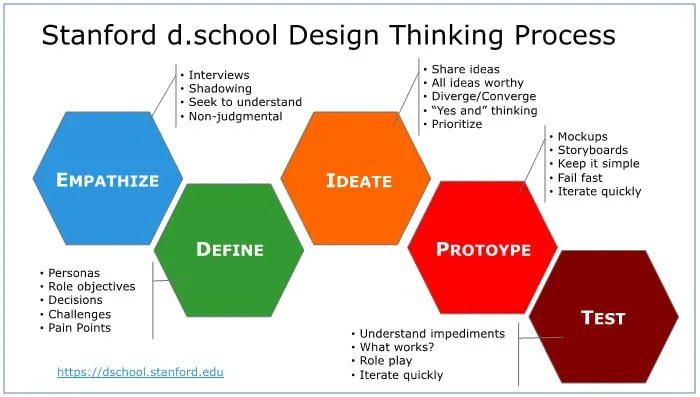
At its core, design thinking was created to solve a very specific problem: How to ensure teams are building the right solutions, not just technically feasible ones, but ones that truly matter to users.
Before its adoption, product development often followed a technology-first approach: Teams built what was possible, then searched for use cases.
Design Thinking reversed that logic. It introduced a Human-centered approach, starting not from the product, but from the user:
Understanding behaviors and context
Identifying real problems
And defining what actually needs to be solved
But more importantly, Design Thinking changed how ideas are treated in the early stages. Instead of being seen as fixed directions, ideas are treated as prototypes - things to be tested, iterated, and refined continuously before reaching product-market fit. This mindset became foundational to how startups operate: not assuming the answer, but discovering it through iteration. Over time, this evolved into a structured process: empathize, define, ideate, prototype, and test, now one of the dominant models guiding product innovation.
This raised a question for me.
If Web2 systems are fundamentally product-driven, and Design Thinking helps us iterate toward product-market fit - what happens in a market like Web3, where outcomes are driven not only by products, but by narratives?
Which leads to a simple but important shift in perspective:
If Design Thinking helped structure product creation, could a similar mindset help structure narrative formation?
If Design Thinking helps teams reach product-market fit, then perhaps a similar mindset could help protocols reach something else: narrative-market fit - a state where the market can understand why something exists, believe in what it could become, and act on that belief.
That idea evolved into what I now call: Narrative Design Thinking.
Enter Narrative Design Thinking
If in Design Thinking, ideas are treated as prototypes to be tested and iterated toward product-market fit, then in Web3, we began to look at narratives in a similar way - not as fixed messages to be communicated, but as hypotheses of belief - something to be tested, refined, and evolved alongside the market.
From this perspective, narrative is no longer just a communication layer on top of the product. It becomes a system that operates in parallel with the product where meaning, interpretation, and belief are continuously shaped and reshaped over time.
Instead of designing campaigns that generate short-term attention, it focuses on designing narrative systems that evolve, diffuse, and accumulate belief within networks. To reach this state, narratives cannot be designed once. They need to be built as a loop - where each phase generates signals that refine the next.
The framework has 5 phases and each phase generates signals that refine the next.
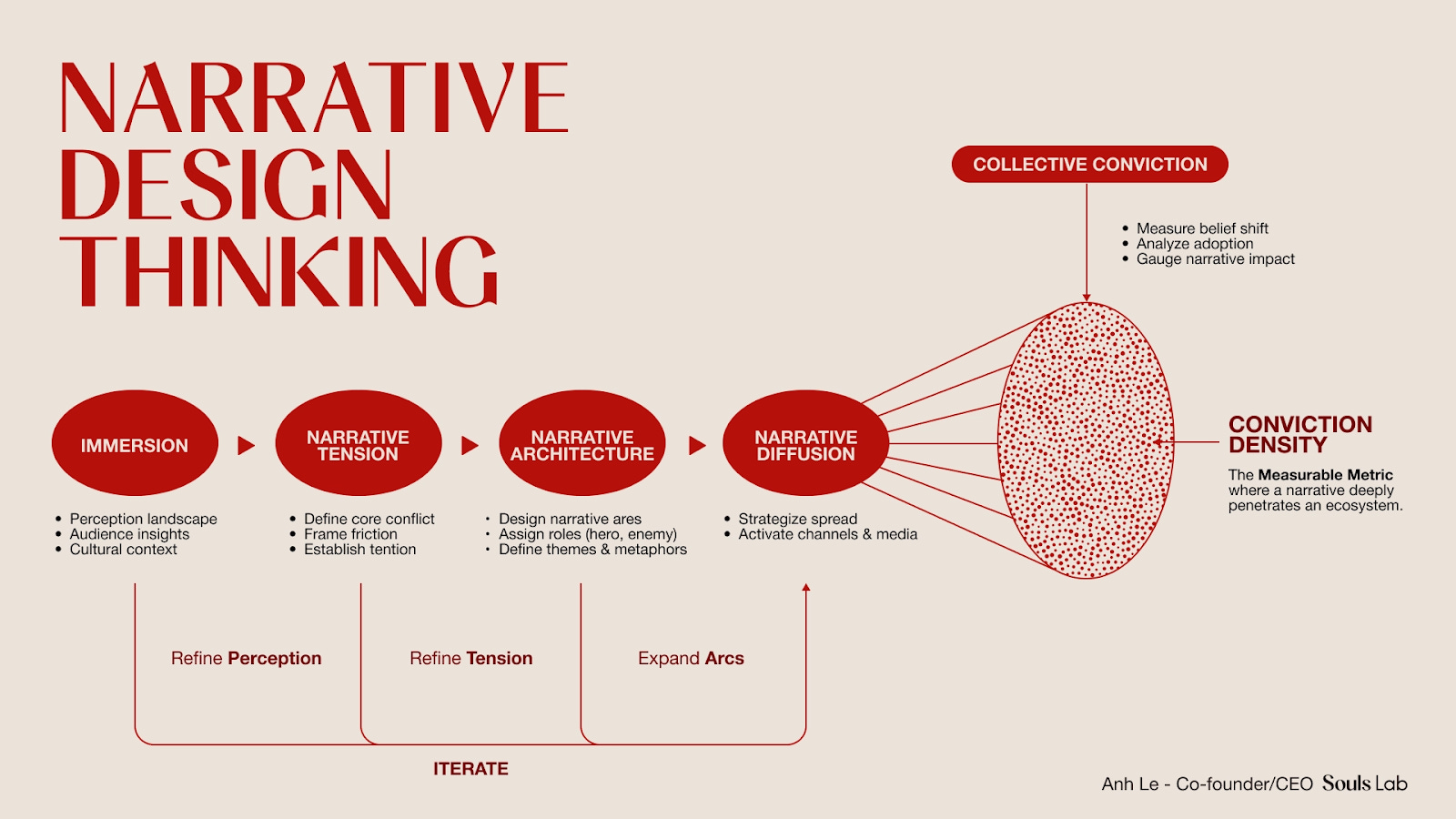
Phase 1: Immersion - Understanding How the Market Sees the World
The starting point is not “what do we want to say” - it is:
How does the market currently perceive the landscape?
What does the audience already believe and care about?
What cultural context is shaping interpretation right now?
At this stage, narrative is not created. It is observed and decoded. Teams should conduct genuine market listening: community conversations, builder sentiment, investor framing, and cultural signals. The output of Immersion is a map of existing beliefs - the substrate into which a new narrative will be introduced.
Phase 2: Narrative Tension - Defining the Core Conflict
Every strong narrative is built on tension:
An unresolved problem that the market recognizes but cannot articulate
A gap between present reality and a desired future
A misalignment in how the market currently understands a technology
This phase is not about storytelling yet. It is about defining the right conflict - the one that the target audience already feels, even if unconsciously. A narrative that introduces tension the market does not recognize will struggle to resonate. A narrative that names tension people already feel will feel like sudden clarity.
Phase 3: Narrative Architecture - Structuring the Story
Once the tension is clear, the narrative begins to take shape:
Who is the “hero” (builder, user, protocol)
What is the “enemy” (legacy system, limitations, assumptions)
Which themes or metaphors simplify the idea
This is where narrative moves from abstraction to a framework others can understand, internalize, and spread. The test of good narrative architecture is not whether it sounds compelling in a pitch deck, it is whether participants in the community begin repeating it in their own words.
Phase 4: Narrative Diffusion - Letting the Narrative Spread
Distribution and diffusion are not the same thing.
Distribution is broadcasting a message to an audience. Diffusion is when participants carry the narrative forward into their own networks, reinterpreting and extending it as they go.
This phase focuses on:
Where the narrative naturally travels - which communities, platforms, and contexts are most receptive?
Who are the credible early carriers - not just KOLs, but builders, researchers, and community members whose endorsement signals genuine conviction?
How does the narrative get reinterpreted as it spreads, and which reinterpretations strengthen vs. distort the core idea?
The shift from distribution to diffusion is when a narrative begins to live outside the team that created it.
Phase 5: Collective Conviction - Measuring How Deeply a Narrative Has Taken Root
The goal of this phase is to measure something specific: not how far a narrative has spread, but how deeply it has been internalized. This is what we call Conviction Density - the degree to which participants in an ecosystem have moved from passively accepting a narrative to actively organizing their behavior around it.
To understand why this distinction matters, it helps to clarify the relationship between two concepts that appear in this framework: Collective Conviction and Conviction Density.
Collective Conviction is the destination - the state a project is trying to reach, where a critical mass of participants share a deep, action-driving belief in what a technology represents and where it is going. It is the outcome.
Conviction Density is the measurement tool - a way to assess how close a project is to that state at any given moment, and whether the narrative is actually building toward it. It is the metric.
Rather than tracking reach or impressions, Conviction Density focuses on four concrete signals:
Organic-to-paid ratio: What share of mentions and discussions happen without incentive? A rising ratio of organic activity signals the narrative is traveling on its own.
Contribution rate: What percentage of the community is actively building, creating, or onboarding others not just following?
Retention under adversity: Does engagement hold when incentives are removed or when the project faces criticism?
Peer recruitment rate: Are members bringing others in without being prompted?
No single metric is definitive, but the pattern across all four tells a clearer story than reach alone and is more predictive of whether a narrative will hold under pressure and compound into long-term growth.
The Loop: Why This Is Not a Pipeline
From Conviction Density, the system feeds back into:
Refining the initial perception map from Immersion
Sharpening the core tension if it is not landing
Expanding or adjusting the narrative architecture
Identifying new diffusion pathways
Just like Design Thinking, narratives are not “launched.” They are continuously iterated. The difference between a campaign and a conviction system is this feedback loop - the willingness to treat the narrative as a hypothesis, not a declaration.
Conviction-Centered Design
At the center of this framework is what we might call conviction-centered design.
When most teams think about narrative, they start with a familiar question:
“What message should we communicate?”
Conviction-centered design begins elsewhere:
“What belief needs to emerge in the market?”
This distinction matters because belief operates at a deeper level than messaging.
Messages can inform. But beliefs are what motivate action.
A strong narrative, therefore, is not just a vehicle for explanation. It is a mechanism for shaping perception over time. It influences how people make sense of the broader landscape:
Which problems feel inevitable
Which futures start to seem plausible
Where participation begins to feel meaningful
As these shared interpretations take hold, something shifts.
Narratives stop behaving like messages being broadcast. Instead, they begin to move through the market organically - repeated, debated, extended, and reshaped by the community itself. At that point, narrative is no longer just about communication, but about coordinating how people interpret reality together.
This is where conviction begins to form.
Importantly, conviction cannot be manufactured through narrative alone.
The role of conviction-centered design is not to impose belief, but to create the conditions in which belief is tested through participation and, through that process, strengthened into conviction.
That requires designing not only the narrative itself, but also the moments of engagement where people can act on what they believe and see those beliefs reinforced in practice.
How We’ve Applied Narrative Design Thinking In Practice
Designing Narratives For Go-To-Market In Vietnam
One of the first times I consciously experimented with this approach was when thinking about how global Web3 projects enter the Vietnam market.
For years, I watched international teams try to replicate the same playbook: influencer shoutouts, translated announcements, airdrop campaigns, short bursts of hype. Sometimes they generated attention. But very rarely did they generate lasting community conviction.
Vietnam has one of the most active crypto communities in the world, but it operates through very specific cultural dynamics: trust travels through communities, conversations, and shared local context.
That observation led me to experiment with a narrative framework inspired by something uniquely Vietnamese:
Cuisine Culture.
Instead of presenting market entry as a traditional GTM playbook, I framed it through three culinary metaphors, each representing a different community-building narrative:
Phở Strategy - Depth and patience
Phở looks simple, but anyone who has cooked it knows how much time it takes. Hours of simmering bones, carefully layered spices, and a slow build of flavor.
This became a metaphor for long-term ecosystem building.
Projects following this path focus on education, developer onboarding, partnerships, and deep community trust. The narrative is not about quick hype, but about becoming part of the local infrastructure.
Bánh Mì Strategy - Speed and cultural energy
Bánh mì is bold, fast, and instantly memorable. Street food that captures attention immediately.
This strategy mirrors fast-moving campaigns designed to spark conversation quickly: meme-driven launches, NFT drops, gaming campaigns, or culturally resonant social activations.
The goal here is not depth but immediate narrative momentum.
Cà Phê Strategy - Conversation and ecosystem embedding
In Vietnam, coffee is less about caffeine and more about conversation. Cafés are where founders meet, builders exchange ideas, and communities gather.
This strategy focuses on narrative through dialogue: founder-led discussions, local meetups, ambassador programs, and long-term ecosystem participation.
It is less about broadcasting messages and more about creating spaces where narratives evolve organically.
What fascinated me about this experiment was that once the framework was shared, people immediately understood it.
Not because it was technically complex, but because the narrative mapped onto cultural intuition.
Food is universal in Vietnam. It carries memory, identity, and shared meaning.
And because of that, the framework traveled easily across conversations.
In retrospect, this small experiment revealed something important to me:
Narratives become powerful when they compress complex strategies into culturally resonant mental models.
If you’re curious to explore this framework in more detail, I wrote a deeper breakdown here:


Designing Narrative for an Institutional Protocol: Newton
Another experiment came from working with Newton, a protocol building an on-chain policy engine. At its core, Newton is infrastructure - it allows developers and institutions to embed compliance, risk controls, and policy rules directly into smart contracts before transactions are executed. It functions as an authorization layer for on-chain activity: closer to financial infrastructure than a typical consumer crypto product.
That created a narrative challenge. The product is powerful, but the story can easily become technical, abstract, and difficult for communities to engage with.
So instead of starting from messaging angles, we started from the core of the project itself: the product architecture, the mission behind it, and the thinking of the team building it. From there, we worked to identify a core idea embedded inside the project - something that could translate complex infrastructure into a belief that people could understand and discuss.
Once a core narrative direction began to emerge, the work became iterative. We tested different framings, observed how the community responded, adjusted the language and distribution channels, and continued until a direction began to resonate organically - signaled not by our pushing harder, but by community members beginning to repeat the ideas in their own words.
Over six months, the results compounded:
The Vietnamese Telegram community grew to over 11,000 members, entirely organically
More than 52,000 participants tuned into Twitter Spaces
The project generated over 200,000 impressions across social channels
We want to be transparent about what these numbers mean and what they do not. In the broader crypto market, these are not extraordinary figures. What made them meaningful was how they happened without aggressive incentives or paid acquisition and the quality of engagement they reflected.
The more important outcome was behavioral: community members were defending the narrative when challenged, recruiting others without prompting, and discussing the protocol’s thesis in their own language. These are signals of conviction density, not just reach.
What remains an open question and one we continue to track is how this community conviction eventually converts into long-term protocol adoption and ecosystem participation. Narrative work that does not compound into product usage is ultimately incomplete. That measurement work is ongoing.
None of the growth happened randomly. It came from a deliberate process: grounding the narrative in the core product and team, shaping it into an idea the market could believe in, and continuously refining it as the community evolved. That is the difference between a campaign and a conviction system.
A Close Thought
The longer I spend in emerging technology ecosystems, the more I realize something fundamental:
Markets are not built by products alone.
Not by capital.
Not even by innovation.
They are built by shared imagination.
Every major technology wave - the early internet, crypto, AI - did not begin when the systems were ready. It began when people started to believe in a story about the future. But the examples in this essay also reveal the other side of that coin: when the story outruns reality, belief collapses - sometimes catastrophically.
The discipline we are describing is not about manufacturing hype. It is about building the conditions under which grounded conviction can form and compound. About helping markets understand not just what is being built, but why it matters and doing so in a way that the product can eventually validate.
Over the past 10 years, I’ve been trying to understand this pattern through my own journey from learning and practicing Design Thinking inspired by IDEO, to studying how storytelling shapes leadership at Stanford GSB, to building Souls Lab, where narrative became a core layer of how early-stage projects go to market.
And over time, everything converged into one realization:
Narratives are the architecture of collective belief.
If technology defines what is possible, narrative defines what becomes inevitable or what collapses when the gap between promise and reality becomes too wide to bridge.
Narrative Design Thinking is not a tool. It is a discipline for those who intend to shape the future - honestly, deliberately, and with an understanding of both the power and the responsibility that comes with the ability to move markets through belief.